Sports Rehabilitation
Getting an athlete out of pain is one job. Getting them back to competing at the level they left is a different one, and most rehabilitation stops well short of it.
That gap is where re-injuries come from.
Why athletes get hurt again
The statistics on re-injury are uncomfortable reading.
A large share of people who sprain an ankle do it again. Hamstring strains are notorious for recurring, often within weeks. Young athletes returning to pivoting sport after an ACL reconstruction face a real risk of tearing it again.
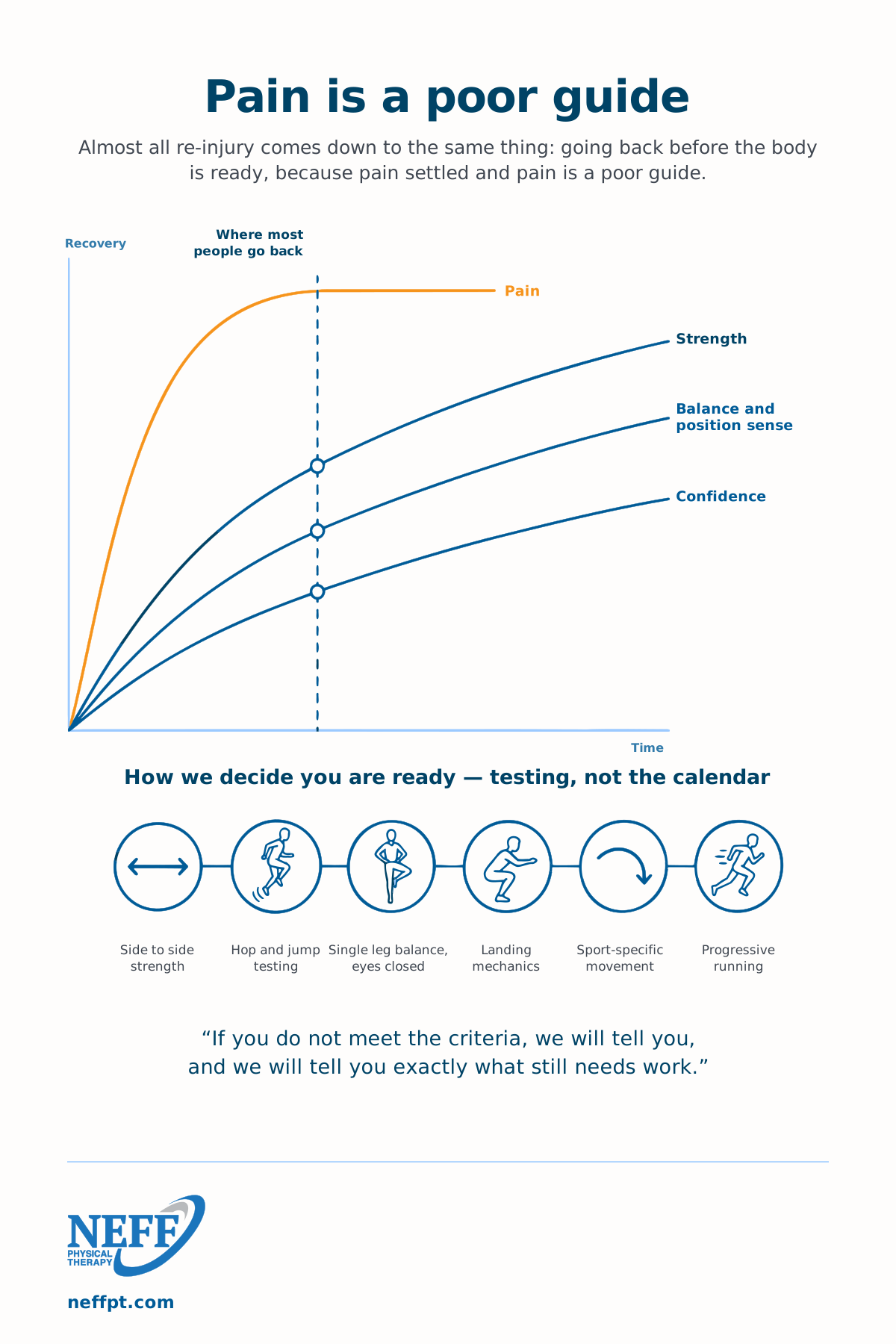
None of that is bad luck. Almost all of it comes down to the same thing: going back before the body is ready, because pain settled and pain is a poor guide.
Here is what actually lags behind pain:
- Strength, particularly at the end of range where injuries happen. A hamstring can feel fine walking and still be well short of what sprinting demands
- Balance and position sense. Damaged ligaments stop reporting position accurately. An ankle can feel normal on flat ground while reacting far too slowly on grass
- Landing and cutting mechanics. Movement patterns change after injury and stay changed
- Exposure to the actual demand. If you were hurt sprinting and have not sprinted since, your first sprint should not be in a game

How we decide you are ready
We use testing, not the calendar and not how it feels.
Depending on the injury and the sport, that includes:
- Side to side strength comparison.We want the injured limb close to the other one, not "good enough"
- Hop and jump testingfor distance, height and control
- Single leg balance,including with eyes closed, which removes vision and exposes the deficit
- Landing mechanics,watching whether the knee collapses inward
- Sport-specific movement.Cutting, pivoting, accelerating, decelerating
- Progressive running,built from jogging through strides to full pace before any return
If you do not meet the criteria, we will tell you, and we will tell you exactly what still needs work. That conversation is not us being difficult. It is the single most useful thing we do for an athlete.
What we treat
Most sports injuries fall into a handful of patterns.
Knee ACL tears, MCL and PCL injuries, meniscus tears, patellar tendinitis, patellofemoral pain and IT band syndrome.
Shoulder Instability and dislocations, labral tears, impingement, rotator cuff tears and separated shoulders.
Muscle strains Hamstring, quadriceps, groin and calf strains.
Foot and ankle Ankle sprains, Achilles problems, shin splints and stress fractures.
Spine Low back pain, neck pain and nerve-related arm or leg symptoms.
Young athletes Osgood-Schlatter and other growth-related problems, which need load management rather than time off.

Young athletes deserve particular care
Growing bodies are not small adult bodies.
Growth spurts change the equation. Bones lengthen faster than muscles adapt, which is why so much youth knee and heel pain clusters around those periods. Bone is also still developing, so repeated stress can affect growth plates in ways it cannot in adults.
Two things matter most here.
Training load. Most preseason injuries follow the same shape: a quiet summer, then daily practice. Tissue adapts over weeks, not days.
Year-round specialization. Playing one sport all year is associated with higher overuse injury rates. Variety spreads the load across different tissues, and it is one of the more useful things a parent can influence.
Prevention here is genuinely effective. Neuromuscular warm-up programs covering landing, cutting and balance meaningfully reduce knee and ankle injuries, particularly ACL injuries in girls, who tear their ACL at notably higher rates in the same sports.
Working with your coach
If you are training around an injury, we will write down what to avoid for now, what you can safely keep doing, and what has to be met before progressing.
Your coach then has something concrete instead of guessing, and you are not caught between conflicting advice.
Ask about it when you book. It costs nothing.

What makes this different here
Dr. Dan Neff coached 12 NCAA All-Americans and an NCAA National Champion. He wrestled at the Olympic Trials himself and serves on the USA Wrestling Medical Staff.
That background matters because it changes the questions asked. Not just "does it hurt" but "can you finish a match", "can you hold position in the third period", "what does your season look like from here".
For wrestlers specifically, see our wrestling injury rehabilitation page.
You also see the same doctor every visit. For a months-long ACL rehabilitation that is not a nicety. Progression has to be judged against how you responded last time, and that requires someone who was there.
Common questions
Find the clinic closest to you
Let's get you moving again
You don't need a doctor's referral to get started. In Pennsylvania we can evaluate you and begin treatment straight away, so you're not sitting on a waiting list for a physician appointment before anyone even looks at the problem.
Some insurance plans still want a referral on file before they'll cover treatment. Give us a call and we'll check your plan with you, so there are no surprises later.
And you'll see the same doctor every visit. Your Doctor of Physical Therapy leads every appointment, and you get hands-on treatment every time. It's how physical therapy is supposed to work.
Still not sure we're the right fit? Call and ask. We'd genuinely rather point you toward the right person than book you an appointment you don't need.
This page is general health information, not medical advice. It cannot tell you what is causing your pain. For that you need someone to examine you in person. If your symptoms are severe, getting worse, or following an injury, talk to a doctor or a physical therapist.