Diagnostic Ultrasound
Diagnostic musculoskeletal ultrasound uses sound waves to produce a live image of soft tissue. It shows muscles, tendons, ligaments, nerves and the surface of joints.
Very few physical therapy practices offer it. It is genuinely useful for certain problems, and it has one advantage no other static imaging has.
What makes it different from an MRI or X-ray
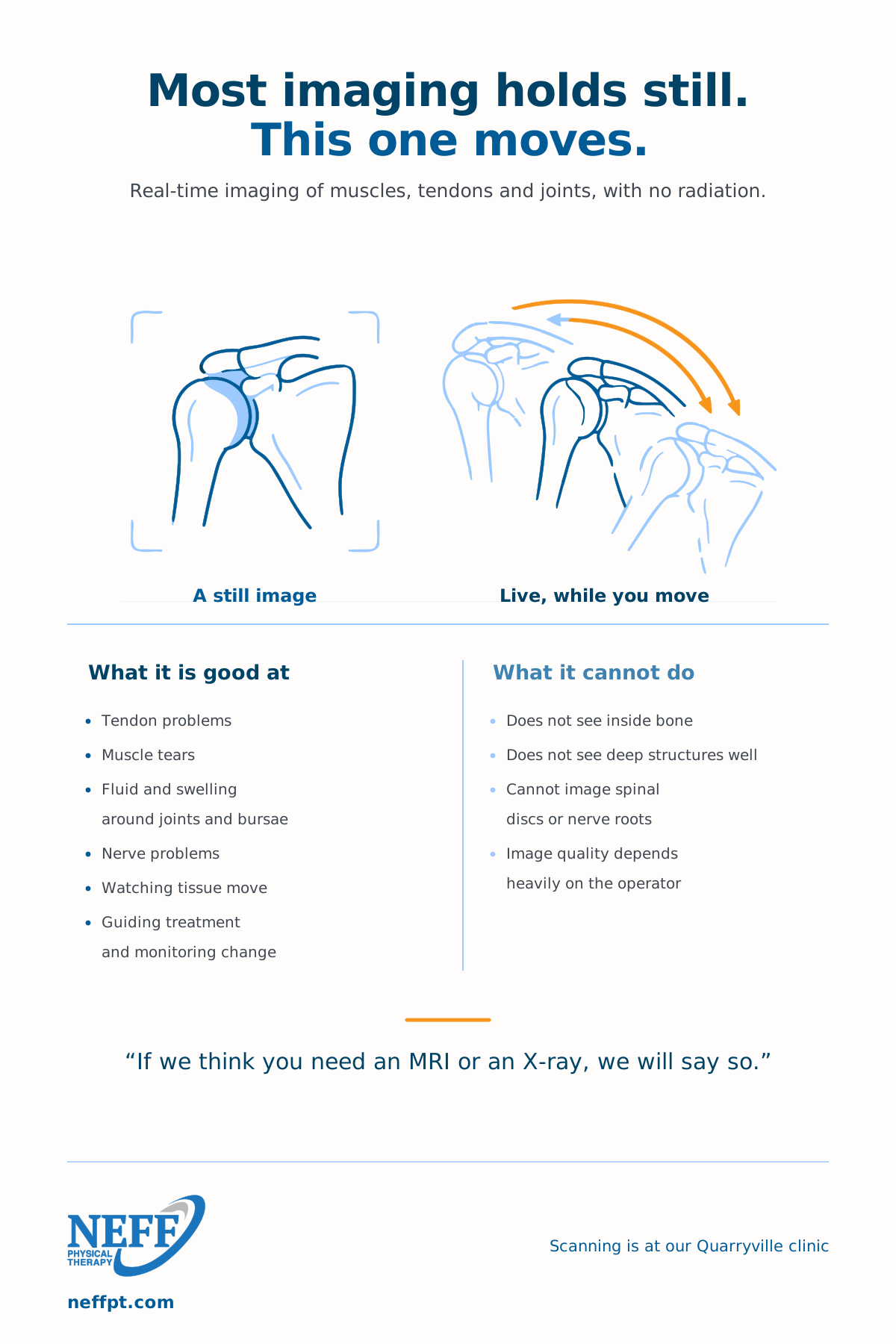
It moves. This is the important one. An MRI is a series of still images taken while you lie motionless. Ultrasound lets us watch tissue while you move.
That matters because some problems only appear during movement. A tendon that catches, a shoulder that impinges as you lift, a nerve that slips over a bone as you bend your elbow. A static image can miss all of those entirely.
Other differences:
- No radiation, unlike X-ray or CT
- Immediate, with images visible during your appointment
- Side to side comparison is straightforward, so we can check the other limb in the same session
- Comfortable, with nothing enclosed and no need to stay still
- Considerably less expensive than MRI
What it is good at
- Tendon problems, including tears and thickening, in the shoulder, elbow, wrist, knee and Achilles
- Muscle tears
- Fluid and swelling around joints and in bursae
- Nerve problems, including carpal tunnel and ulnar nerve issues
- Watching tissue move, which is where it beats static imaging
- Guiding treatment and monitoring change over a course of rehabilitation
What it cannot do
Being clear about the limits is as useful as the strengths.
- It does not see inside bone. Fractures, bone stress injuries and bone marrow changes need X-ray, CT or MRI
- It does not see deep structures well, including the inside of the hip joint and most of the spine
- It cannot image spinal discs or nerve roots. Neck and back problems need other imaging
- Image quality depends heavily on the operator, more so than with MRI
So it is very good for certain questions and the wrong tool for others. If we think you need an MRI or an X-ray, we will say so.
Our credentials for this
Our scans are performed by Dr. Dan Neff, Dr. Kristopher Davis and Dr. Adam Soltys, at our Quarryville and Oxford clinics.
We are a Hands On Diagnostics approved diagnostic center, and the practice has joined a nationally credentialed Fellowship program for musculoskeletal ultrasound.
This matters more for ultrasound than for most imaging. Image quality and interpretation depend heavily on the operator, more so than with MRI, so training is not a formality.

What the appointment involves
Gel is applied to the skin and a small handheld probe is moved over the area. It is painless, though the gel is cool.
We will usually ask you to move the limb during the scan, since watching tissue move is much of the value. We will often scan the other side too, for comparison.
You can see the screen throughout, and we will explain what you are looking at as we go. Most people find that genuinely useful, since seeing your own tendon on screen makes the explanation concrete in a way words do not.
There is no preparation, no radiation, and nothing to recover from.

Conditions we use this for
Common questions
Find the clinic closest to you
Let's get you moving again
You don't need a doctor's referral to get started. In Pennsylvania we can evaluate you and begin treatment straight away, so you're not sitting on a waiting list for a physician appointment before anyone even looks at the problem.
Some insurance plans still want a referral on file before they'll cover treatment. Give us a call and we'll check your plan with you, so there are no surprises later.
And you'll see the same doctor every visit. Your Doctor of Physical Therapy leads every appointment, and you get hands-on treatment every time. It's how physical therapy is supposed to work.
Still not sure we're the right fit? Call and ask. We'd genuinely rather point you toward the right person than book you an appointment you don't need.
This page is general health information, not medical advice. It cannot tell you what is causing your pain. For that you need someone to examine you in person. If your symptoms are severe, getting worse, or following an injury, talk to a doctor or a physical therapist.