How We Treat
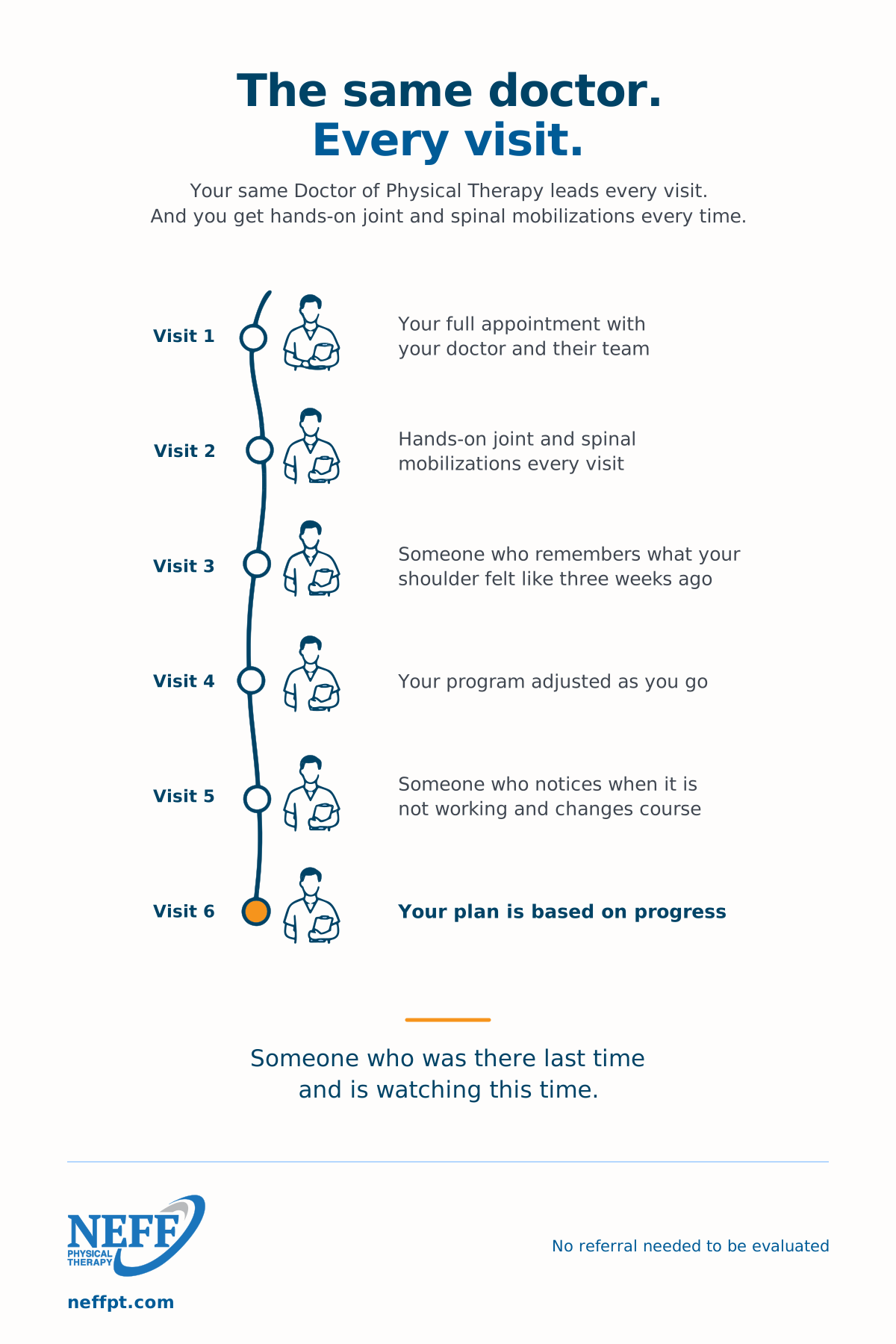
We do it the way it is supposed to work. Your same Doctor of Physical Therapy leads every visit. And you get hands-on joint and spinal mobilizations every time.
That is the entire model, and everything else follows from it.
What that means for you
- The same doctor every visit. Someone who remembers what your shoulder felt like three weeks ago and can judge whether today's change matters
- Your full appointment with your doctor and their team
- Hands-on joint and spinal mobilizations every visit
- Your program adjusted as you go
- Someone who notices when it is not working and changes course, or tells you honestly that you need a different kind of help
Why this changes outcomes
Rehabilitation is mostly about progressive loading. Doing slightly more than last time, at the right moment, for weeks on end.
Getting that progression right is a judgment call, and it has to be made against how you responded last time. Too little and nothing changes. Too much and it flares, you lose confidence, and you go backwards.
Making that call requires someone who was there last time and is watching this time. It cannot be made from a chart by someone seeing you for the first time.
That is not a marketing claim about caring more. It is the practical reason the model produces better results.

What your first visit looks like
Your first appointment is an evaluation, and it is longer than a normal treatment session.
- Listening to what happened, what makes it worse, what you have already tried, and what you actually need to get back to
- We examine you, which means testing movement, strength and, where relevant, nerve function
- We explain what we think is going on, in plain language
- We start treatment that day. You do not come back a second time to begin
- You leave with a world class spinal and joint treatment, a clear plan, a realistic timeline, and a small number of things to do at home
If we determine you need a different specialist, a surgeon, or imaging before therapy, we will tell you at that visit.
What we will not do
Worth being direct about.
- We will not sign you up for a fixed block of visits regardless of how you respond. Your plan is based on progress
- We will not keep treating you if it is not working. We will change the approach or will refer you to the appropriate specialist
- We will not pretend everything is treatable by physical therapy. Some things need a surgeon, and some need a different specialist, which we are trained to recognize
Do you need a referral
No, not to be evaluated. In Pennsylvania a physical therapist can assess and begin treating you without a doctor's referral first.
Some insurance plans still require a referral before they will cover treatment. That is a coverage question rather than a legal one, and it varies by plan. Call us and we will help you work out where you stand before you commit to anything.

Conditions we use this for
- ACL Tear
- Achilles Tendonitis and Rupture
- Ankle Sprain
- Anterior Knee Pain
- Avascular Necrosis of the Hip
- Calf Strain
- De Quervain's Tenosynovitis
- Distal Radius Fracture (Broken Wrist)
- Fibromyalgia
- Foot and Ankle Fractures
- Forearm Fracture
- Groin Strain
- Guyon's Canal Syndrome (Handlebar Palsy)
- Hamstring Strain
- Headaches and Migraine
- Hip Arthritis
Common questions
Find the clinic closest to you
Let's get you moving again
You don't need a doctor's referral to get started. In Pennsylvania we can evaluate you and begin treatment straight away, so you're not sitting on a waiting list for a physician appointment before anyone even looks at the problem.
Some insurance plans still want a referral on file before they'll cover treatment. Give us a call and we'll check your plan with you, so there are no surprises later.
And you'll see the same doctor every visit. Your Doctor of Physical Therapy leads every appointment, and you get hands-on treatment every time. It's how physical therapy is supposed to work.
Still not sure we're the right fit? Call and ask. We'd genuinely rather point you toward the right person than book you an appointment you don't need.
This page is general health information, not medical advice. It cannot tell you what is causing your pain. For that you need someone to examine you in person. If your symptoms are severe, getting worse, or following an injury, talk to a doctor or a physical therapist.