Balance and Dizziness Program
Dizziness and balance problems are common, disruptive, and frequently dismissed. A great many people are told to wait it out, or simply that it happens with age.
Often that is not accurate. Some causes of vertigo can be resolved in a single appointment, and balance itself is trainable at any age.
The one that is often fixed in one visit
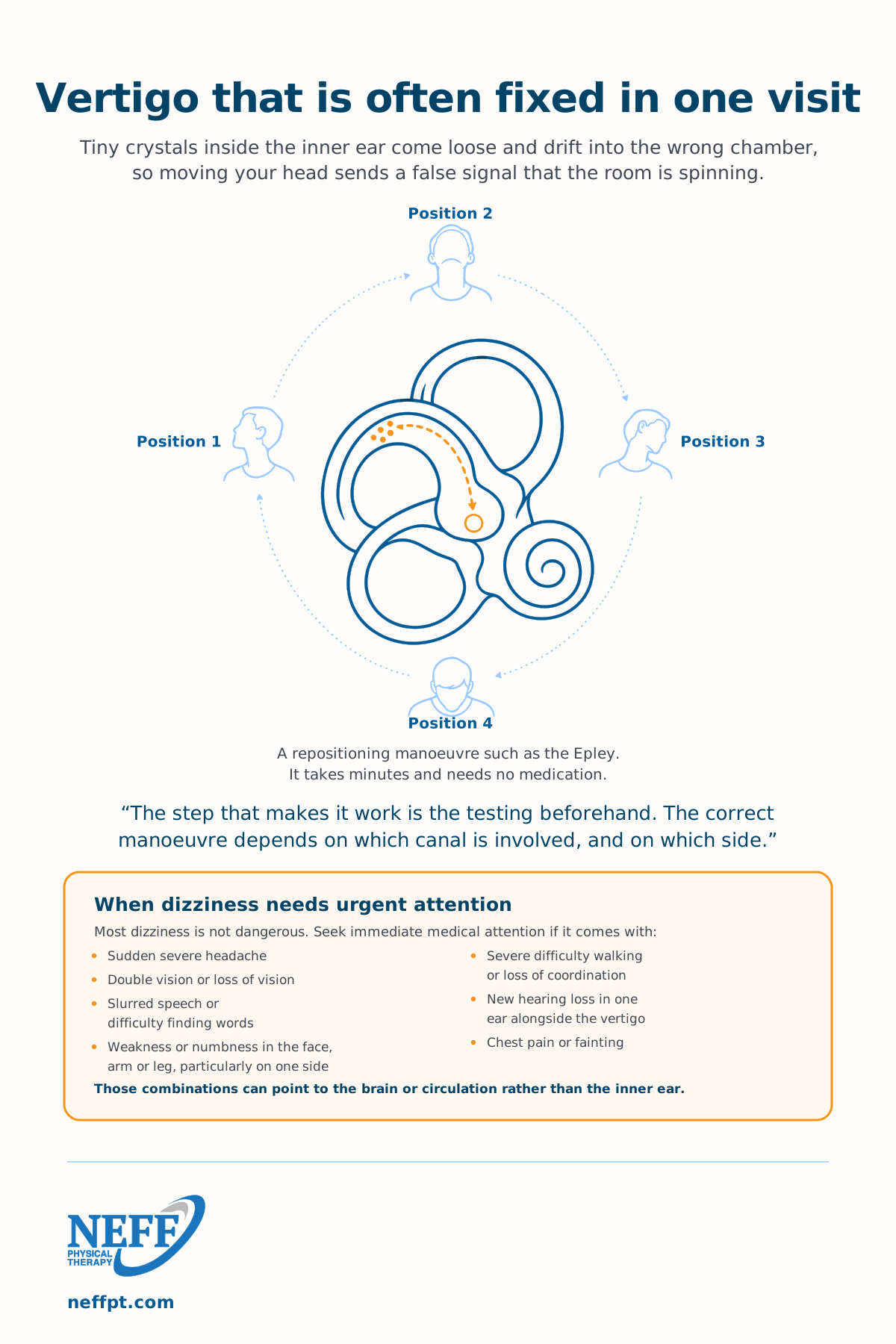
BPPV is the most common cause of vertigo. Tiny crystals inside the inner ear come loose and drift into the wrong chamber, so moving your head sends a false signal that the room is spinning.
It is treated by physically moving those crystals back where they belong, using a repositioning maneuver such as the Epley. It takes minutes, needs no medication, and the success rate is high. Many people are substantially better after one treatment.
The step that makes it work is the testing beforehand. There are several canals and several variants, and the correct maneuver depends on which one is involved and on which side. That is why treating yourself from a video often disappoints.
Read more about vertigo and BPPV.

Other causes we treat
- Vestibular hypofunction, where one inner ear is underperforming, often after a viral infection. Treated with exercises that retrain the brain to compensate
- Dizziness after concussion, which responds well to vestibular rehabilitation. See concussion
- Cervicogenic dizziness, originating from the neck rather than the ear
- General unsteadiness and falls risk in older adults
- Balance loss from peripheral neuropathy, where reduced sensation in the feet is the driver. See peripheral neuropathy
- Balance problems after joint replacement or long periods of inactivity
Why falls prevention matters so much
Falls are a leading cause of serious injury in older adults, and a hip fracture frequently marks the end of someone's independence.
The encouraging part is that this is one of the better-evidenced areas in all of rehabilitation. Balance and strength training genuinely reduces falls in older adults. It is not a vague wellness measure, it is a specific intervention with real effect.
There is also a cycle worth breaking. People who feel unsteady do less. Doing less causes weakness and worse balance. Worse balance causes falls. Confidence is part of the treatment, not a side benefit.
What your assessment involves
- A careful history, since the pattern of your dizziness is the most informative thing available
- Positional testing,where we briefly provoke the vertigo while watching your eyes. The eye movement is what identifies which canal is involved. This is unpleasant for a minute or so and we will warn you before we do it
- Balance testing, on different surfaces and with eyes open and closed
- Strength testing
- Walking assessment
- Screening for the causes that need a physician rather than a therapist
If it is BPPV, we treat it in the same visit.
When dizziness needs urgent attention
Most dizziness is not dangerous. Seek immediate medical attention if it comes with:
- Sudden severe headache
- Double vision or loss of vision
- Slurred speech or difficulty finding words
- Weakness or numbness in the face, arm or leg, particularly on one side
- Severe difficulty walking or loss of coordination
- New hearing loss in one ear alongside the vertigo
- Chest pain or fainting
Those combinations can point to the brain or circulation rather than the inner ear.
Conditions we use this for
Common questions
Find the clinic closest to you
Let's get you moving again
You don't need a doctor's referral to get started. In Pennsylvania we can evaluate you and begin treatment straight away, so you're not sitting on a waiting list for a physician appointment before anyone even looks at the problem.
Some insurance plans still want a referral on file before they'll cover treatment. Give us a call and we'll check your plan with you, so there are no surprises later.
And you'll see the same doctor every visit. Your Doctor of Physical Therapy leads every appointment, and you get hands-on treatment every time. It's how physical therapy is supposed to work.
Still not sure we're the right fit? Call and ask. We'd genuinely rather point you toward the right person than book you an appointment you don't need.
This page is general health information, not medical advice. It cannot tell you what is causing your pain. For that you need someone to examine you in person. If your symptoms are severe, getting worse, or following an injury, talk to a doctor or a physical therapist.